
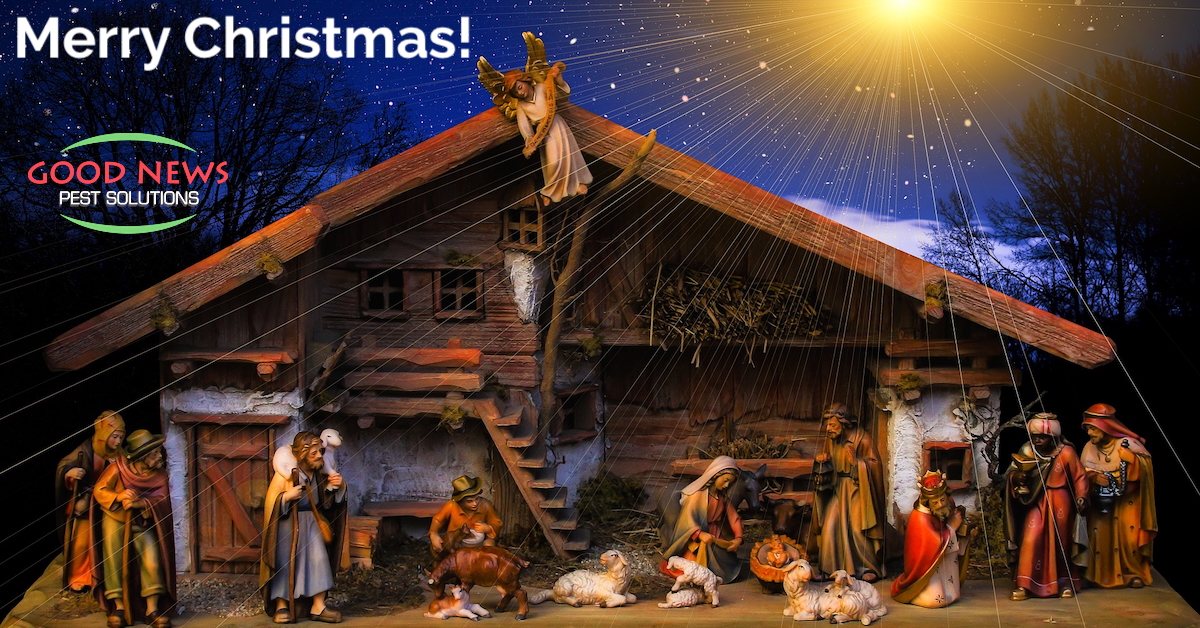
Merry Christmas!
Today, across the globe, more than 2 billion people will celebrate Christmas, the day set aside to commemorate the birth of the baby Jesus. Not everyone is focused on the Christian roots of the holiday, but many of even the secular traditions were inspired by events and celebrations recorded nearly 2000 years ago.
The earliest Christians did not celebrate Jesus’ birth, and nowhere in the Gospel accounts is a date specified. The first century believers were more centered around the death and resurrection of their savior and remembering that day every year.
Earliest Days
The oldest surviving Christian commentary on scripture is Hippolytus of Rome’s Commentary on Daniel, from 204 AD. Within Hippolytus’ text, along with comparing the Roman persecution of his day with that of Shadrack, Meshack and Abendego, he also records a date for Jesus’ birth: the 25th day of the ninth month of Kislev, coinciding with Hanukkah.
Later historians would dispute that, claiming a November, April or March birth. There’s evidence some people in the first and second century celebrated Christmas – if they did at all – much closer to Easter. Jews and early Christians didn’t honor birthdays feeling that those celebrations felt too Roman, too pagan. But shortly after Constantine made Christianity the official faith of the Roman Empire, things aligned and December 25 became the unofficial date of the Mass for Natus Christus, later standardized by the church.
Interestingly enough, other holidays that early people of faith celebrated also point to a potential December birth. The feast of Epiphany, remembering the visit of the Magi or eastern wise men, falls on January 6. Today we refer to Epiphany as the 12th day of Christmas. The church also sets the Annunciation – the day the angel came to tell Mary she was pregnant – on or about March 25. If you do the math, 9 months later is Christmas Day.
There’s also a Hebrew tradition that the holiest of men die on the same day they were born. So if Jesus was conceived in the spring and born in the winter, his death on the cross, also in the spring, would be 33 years later on Easter weekend.
But church leaders will tell you the exact date is far less important than what the day means.
Meaning for the Season
Many see Christmas as only a time for decorations, gifts, meals and family time. Jesus’ birth has been relegated to one aspect of the season, rather than the primary. But even those seemingly less-than-sacred practices have their origins in the Christian faith. Giving gifts to one another reflects the recorded gifts of the Magi for Jesus, although you’re less likely to see gold, frankincense and myrrh these days.
Evergreen trees have a long history of significance for the Celts and their druidic priests. In Germany, the fir trees evolved as a symbol of Christ’s eternal life. Martin Luther, the German reformer, embraced the symbolism, adding candles reminiscent of all the stars in the sky. Eventually, these Christmas trees spread with immigrants to the Americas and were also adopted by the Catholic church.
St. Nick
Even Santa Claus, now a stalwart of commercialism and animated TV specials, has his roots in Jesus’ birth. Bishop Nicholas, the primary inspiration for Santa, was known throughout the land for his generosity to those in need, his love for children, and his concern for sailors and ships. He was born in Turkey and orphaned early, deciding even at a young age to donate his inheritance to help the needy, sick and poor.
One story goes that a father with three daughters could not afford a dowry for any of them. Bishop Nicholas found out and snuck up to the house in the dead of night, tossing a bag of gold coins in the window and disappearing before anyone could see. He returned to give money for each of the daughters and was spotted by the father on his third effort but swore the man to secrecy.
Over the years, the Bishop of Myra became known as Saint Nicholas, then later “Sinteklaas.” In 1822, Clement Clark Moore penned a now famous poem about the legend, “A Visit from St. Nicholas.” Elements from this poem were used to create the now iconic image of the man in the red suit, furthered by Coca Cola and artist Haddon Sundblom, as part of an ongoing advertising campaign.
Many Times, Many Ways
Believe it or not, for many years almost no one in England and America celebrated Christmas. In 1645, Oliver Cromwell, Lord Protector of England, hated religion and outlawed Christmas. The Puritans who came over on the Mayflower also outlawed Christmas and fined people who celebrated. After the American Revolution in 1776, Christmas sort of disappeared in the new nation.
Two stories published in the 1800s redefined how we saw Christmas. Washington Irving, who also wrote about the Headless Horseman, published The Sketchbook of Geoffrey Crayon, gent., and Charles Dickens, to keep his family from becoming homeless, penned the iconic A Christmas Carol. Irving’s collection of stories and Dickens’ tale of goodwill and Christmas cheer painted pictures of what the holiday season still looks like today.
Family time, greeting cards, decorating and gift giving quickly gained popularity, along with generosity for the poor, feeding the hungry, and sharing Christmas joy. In 1870, Christmas became an official federal holiday.
Today, Christmas is bigger than ever, even as the economic times get tighter. Just remember, it’s not about the things you buy, but the spirit of the season that should define Christmas.
From all of us here at Good News Pest Solutions, we send good tidings to all and hope you and your family and friends have a blessed and joyful Christmas Day. We will be back in the office tomorrow.
« Back to BlogProudly Serving
Sun City Center, Ruskin, Palmetto, Parrish, Ellenton, Bradenton, Anna Maria, Holmes Beach, Bradenton Beach, Longboat Key, Lakewood Ranch, University Park, Myakka City, Sarasota, Siesta Key, Osprey, Nokomis, Casey Key, Venice, Englewood, North Port, Port Charlotte, Punta Gorda, Arcadia
Things You Can Do
Pay Your Bill Online
Leave Us a Review
Request a Free* Termite Inspection
Stop Mosquito Bites
Get Rid of Rodents
Get a Termite Damage Warranty
Get Pest Control for Your Attic
Get Pest Control for Your Business Request Prayer
Corporate Address
1080 Enterprise Court, Ste A
North Venice, FL 34275
Call Now: (941) 412-9610
Text: (941) 412-9610
Fax: (941) 412-0080