
Like most of the insects here on the Gulf Coast of Florida, termites are active year-round. But there are times during the year when they’re a bit more active, for various reasons. March to June is, more or less, termite season. That’s when they swarm.
If we have unseasonably early rains, subterranean termites may swarm as early as February, through May. Drywood termites tend to swarm from March through August. Formosan termites, our biggest threat, do most of their swarming during April and May.
During the swarm season, termite colonies produce large numbers of winged reproductive termites – between a dozen and hundreds of termites – called swarmers or alates. The scientific name for termites, Isoptera, comes from the Greek, for "equal wings." These flying termites leave their colony to pair off, mate, and build a new colony. So imagine, one mature colony of termites can send out alates to start countless new colonies.
We’ve talked before about how much damage termites can do to your home – costing homeowners over $5 billion annually. Termites often can destroy significantly even before you notice them. One winged termite isn’t necessarily an issue, but if you see multiple, it’s likely you already have a colony in or near your home. If that’s the case, call an expert.
But aside from their destructive nature, termites are incredible creatures. For the next couple of weeks, we’re going to share some of the most interesting factoids about this remarkable insect.
They Grow and Build
There are more than 2700 species of termites across the globe. After two alates connect and mate, they become king and queen, and the colony building begins. Each termite queen can lay up to 30,000 eggs every day. Queens can live anywhere from 15 to 50 years, producing millions of eggs. In fact, they usually outlive the king and one of her male offspring is promoted to be her new mate.
Unlike most species, the most important termites are fed the least. As strange as it sounds, the alates, the potential new royalty, are fed less than the worker termites. This allows them to grow lean and strong in one way. Meanwhile the workers are built for, well, work, and the additional food causes them to develop higher, energy rich and efficient metabolisms.
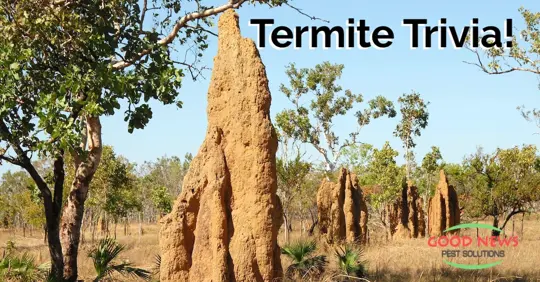
While we often talk about termites living in our homes, foundations and walls, they are most obvious in their giant mounds. These termite mounds are usually spotted in the Australian outback and some parts of Africa. These “chimneys” can reach heights of 26 feet tall.
Northeastern Brazil also has some pyramid shaped mounds. Each of the caatinga mounds is 8 feet wide, and nearly 30 feet high. Did we mention there are around two hundred million of these mounds, in an area about as big as the state of Oregon. They can actually be seen from outer space!
Genetic Anomalies
Termites are actually classified as cockroaches. Yes, you read that right. In 2007, scientists discovered genetic information that pointed to a common ancestor for both roaches and termites. Some 170 million or so years ago, Cryptocercus, a wood eating cockroach, started to evolve in a way that made wood even more palatable, and their instincts more communal. It happened in what we now think of as Asia or Africa, although at the time it was believed that most of the world’s land mass was a single continent, Pangea.
More recently, the University of Sydney, Australia, found the changes didn’t come about in what geneticists call the usual way. Most mutations come from added or altered genes. This new study, published last month, indicates that these pre-termite roaches lost genes to become more social. Specifically, termites shed genes that forced them to fight over male spermatazoa, making them monogamous.
An international team of scientists from China, Denmark, and Colombia participated in the study that linked the turn to eating cellulose (wood) with the loss of those genes. As they became more social and more dependent on each other, they shed even more genes, altering their metabolism and how they digested the wood. Weirdly, this de-volution allowed termites to become one of the most dominant species on the planet, along with humans and ants.
Next week we’ll give you some more fun facts about termites and tell you what to look for in your home to avoid or identify an infestation.
Protection by the Numbers
Termites are a serious problem for homes here in the Sunshine State. Every home either has a termite problem or will at some point. That’s why we offer both our pre-construction treatment and our Term Assure 365+. Our pre-construction Bora-Care treatment prevents and eliminates termites, carpenter ants, powderpost beetles, and old house borers. It also kills and prevents algae and wood decay fungi.
Term Assure 365+ combines our popular Perimeter Plus pest control with a full home inspection and installation of always active termite bait stations. It’s the most comprehensive termite protection you can buy. And it includes a $1 million subterranean termite repair warranty, something your homeowner’s insurance doesn’t cover. For complete details, or to schedule your appointment, please give us a call!