
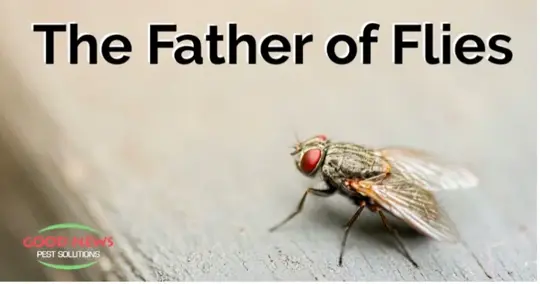
John Merton Aldrich was born Jan. 28, 1866, in Olmsted County, Minnesota, one of seven children. A hundred and sixty years ago, we didn’t know much about insects, and even less about flies. Aldrich changed all that. Not only was he instrumental in discovering rare insect species, his in-depth study of two-winged flies, or diptera, is still considered the most authoritative work, 120 years after he published it.
Early Days
Growing up on a farm in Minnesota, Aldrich became enamored with the natural world and how things worked. When his family moved to South Dakota, his course was set. At 19, he enrolled in Dakota Agricultural College (now South Dakota State University), where he finished a four-year degree in just three. Leaving agriculture behind, in his third year he was taken under the wing of Professor Isaac H. Orcutt, who would set the course for Aldrich’s further studies.
Orcutt pushed his students to do independent study, and Aldrich scoured the countryside around the university, armed with only a butterfly net and a mason jar, collecting water bugs, slugs, beetles, butterflies, and dragonfly larvae. He later innovated the use of the new electric lights to attract even more bugs for his collection.
After graduation, he was hired by the College to assist with their growing entomology and zoology departments, even helping found the Agricultural Experiment Station. Aldrich spent a short time studying entomology with Otto Lugger at the University of Minnesota, and Albert J Cook at Michigan State University. It was apparently Cook who suggested to Aldrich that he should focus his studies on a single order of insects.
in 1893, Aldrich became the first zoology professor at the University of Idaho. There he focused his studies on agricultural pests. He studied the codling moth (Cydia pomonella), a major threat to apple production, grasshoppers, mosquitoes, and the boxelder bugs. His work is still considered the foundation of pest control for many of those insects. He also met his first wife, Ellen J. Roe. Unfortunately, their first child died early and Ellen passed a couple of years later. Aldrich poured his grief into his new academic focus: Diptera.
Fly Away Home
For seven years, Aldrich relentlessly pursued a new study, one that would become his life- defining work. He had, for years, been collecting specimens and documenting fly behaviors, such as courtship rituals, but now two-winged flies became his obsession. Finally, he felt he had completed his Catalogue of the North American Diptera, published by the Smithsonian in 1905.
Aldrich married his second wife, then took a yearlong sabbatical to study at Stanford, where he submitted the Catalogue as his doctoral thesis. Armed with a fresh PhD., he returned to Idaho to find the University had burned to the ground. Thankfully, all of his research and specimens had been stored off-site and were not destroyed.
He spent another few years in academia before moving to the USDA Bureau of Entomology in Lafayette, Indiana. His previous experience served him well, and he added to his canon, spending 5 years studying agricultural pests for cultivated grains, while also publishing more fly research in Sarcophaga and Allies in North America in 1916.
In 1918, Aldrich became the Associate Curator of Insects and the Custodian of Diptera at the United States National Museum in Washington, D.C. He held that position until his sudden death in 1934. In 1928, he formally donated his collection to the Smithsonian. It contained more than 45,000 specimens, consisting of more than 4000 species, along with a definitive card catalog file of North American literature on these specimens.
John Merton Aldrich was elected president of the Entomological Society of America in 1921, and at the time of his death had published more than 100 scientific papers. He was also an active member of his church.
Legacy
Aldrich’s work on both two-winged flies and agricultural pests remains the foundation for understanding and pest control to this day. Though he may not be remembered with a national holiday, his work is known and recognized by entomologists across the globe. You can thank him, as we here at Good News Pest Solutions do, for his seminal work in making our lives and jobs easier.
But as interesting as all that is, we realize the main thing most people worry about is keeping two-winged flies out of their house. The biggest factor in preventing a housefly infestation is being conscientious with your cleanliness. Regularly remove trash. Only discard trash in well-sealed garbage receptacles – both inside and out. Clean up pet waste in your home or yard as soon as you’re aware of it. You can also upgrade your windows and doors with fine mesh screens. And if your problem is really big, call a professional.
Our Go Green Perimeter Plus service handles spiders, roaches, silverfish and ants, but we also have more than 30 years of experience taking care of house flies. If you need help, please give us a call!