
It’s beginning to look a lot like Christmas… As much as the Gulf Coast of Florida ever does. Portable pumpkin patches have become Christmas tree farms. Lights are twinkling on the palm trees. And parking at the mall is a nightmare. In just a few days, boats will line up for the annual Christmas light parade and the Surfing Santas will organize on Cocoa Beach.
As strange and unusual as some of the Florida Christmas customs are, did you know we have some Christmas insect traditions too? Various bugs (and arachnids) over the years have gotten a curious connection to the birth of the Christ child.
The Christmas Wasp
One of the earliest yuletide insect tales is one of the strangest. The Brothers Grimm, responsible for collecting the folklore stories that inspired many of your favorite Disney films like Snow White, Sleeping Beauty & Cinderella, tell the tale of a farmer who convinced the devil to stick his hand into a wasp’s nest, then tried to ask the angry wasps for a favor.
Later the tale took a darker turn, with the Wasp King becoming a dark alternative to Saint Nicholas, doling out punishments, maybe at random, or maybe just on misbehaving children. Like the German Krampus, in Britain, youngsters were warned to be on their best behavior lest the Christmas Wasp come and sting them.
The Christmas Wasp is described as a larger than usual wasp with yellow and black stripes. He has a stern expression and generates a very irritating buzzing. What’s perhaps even stranger is the fact that the symbol of the Christmas Wasp is spotted everywhere this time of year.
Part of the Wasp King tradition is to bake dark rye and light wheat “wasp cakes,” called Hvepekager that are left out on the night of the Winter Solstice. Some British candymakers developed a sweet based on Hvepekager, but the yellow and black color bothered them, so they changed the sweet canes to have red and white stripes.
Our Lady’s Bug
Another Middle Ages tale is that of the destructive, sap-sucking aphid. There are hundreds of species of aphids. After being born, aphids fully mature in 7-10 days and can lay eggs – 40 to 60 at one time. Very quickly in the 5th century, tree and root aphids were ravaging the countryside of England and Europe.
Christians, primarily Catholics, came together and prayed for God to deliver them. Shortly thereafter, a little red beetle with black spots appeared on the scene and started cleaning house, gobbling up the aphids.
Sensing God’s provision, these religious folks named the “new” bugs in honor of Jesus’ blessed mother, the Virgin Mary – “Our Lady’s Bugs.” That eventually got shortened to ladybugs. As a result of their helpfulness in this time of crisis, it is still common to see ladybug ornaments on Christmas trees in the old country.
Gaelic Bees
In Celtic traditions, bees are seen as wise messengers who could travel between worlds. They carried missives from their three world dimensions: upperworld to middle world to underworld. As Christianity spread across Europe, many of the old Celtic and Druidic practices were adapted to fit the new model of faith.
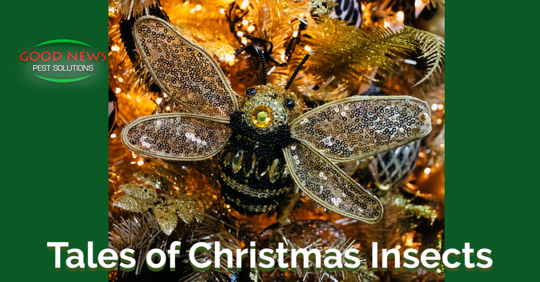
Honeybees gained a voice that only those who have ears can hear. Tradition says they “sang” to Jesus on the day of his birth – and only those who have lived a blameless life can hear them. Honeybee ornaments also get hung on trees.
Ugly Outside, Tasty Inside
If you’ve never been to South Africa, you may not know the wonderful flavor of the deep fried Christmas caterpillar. We’re told they’re delicious. We’ll take their word for it. The protein-rich caterpillar is the larva of the Pine Emperor Moth and has bright red and green colorations, similar in appearance to an ugly Christmas sweater.
Christmas Spider
Eastern European legends provide the story for the “creator” of tinsel. We’ve told the story of the Christmas Spider before, but to refresh your memory, a poverty stricken widow and her children had a homegrown Christmas tree, but no means to decorate it. Some legends say the spider heard their prayers, others that Bishop Nicholas prayed to Jesus on the family’s behalf.
During the night, spiders brought leaves and bright berries to adorn the tree along with their sparkling spider silk and cobwebs. When the sun hit the tree, it glittered like silver and gold and the spider webs were transformed. It is said the family was never found wanting again but spread their resources generously to others.
While many Christmas trees have sparkly tinsel, Ukrainian families often hang little pavuchky ornaments made of paper and wire in the shape of a spider on their trees and see spiders as a sign of good luck.
G’Day, Mate
In the land down under, specifically New South Wales, every year around Christmas they look forward to the swarming of the Christmas beetle. Dubbed “Nature’s Christmas decorations,” the lights the beetles swarm around transform their metallic looking outer shells into an explosion of color reminiscent of your grandparents’ Christmas trees in the 60s and 70s.
Butterflies and dragonflies are other colorful flyers that sometimes symbolize wisdom, prosperity, rebirth, or other worldliness that often find their way onto Christmas trees as well. Next week, we’ll talk about some of the bugs that get “smuggled” into your house – by you – when you put up the Christmas tree.
Of course, if any of these real bugs show up indoors, you’ll want them removed as soon as possible, along with the ants, roaches and, sometimes even, Christmas spiders. That’s where we come in. Our Go Green Perimeter Plus locks these creepy crawlies out and keeps them from coming back in. For more details, please give us a call!