
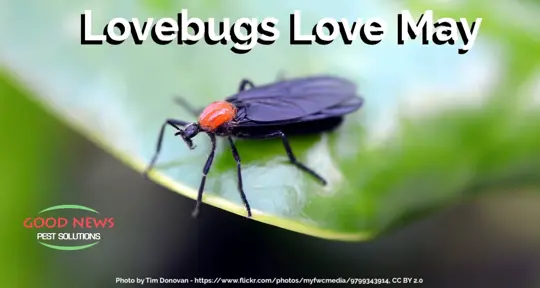
It’s hard to believe it’s that time of year again. But along with May Day, the May Pole, Asian American and Pacific Islander Heritage Month, and National ALS Awareness Month, come… Love Bugs.
For decades, Plecia nearctica was a serious threat to your car’s paint job. Mysteriously, the bugs known for mating in mid-air over your local Florida freeway seemed to have significantly diminished in the past couple of years. But they’re back, baby!
Aerial Pairing
The second or third most annoying insect on the Gulf Coast of Florida gets their common name from the fact that we see them almost exclusively during their mating season. From April to May and August to September every year – yes, twice a year, and sometimes also in December – love bugs take flight.
Males find females and they connect tail to tail in an aerial ballet. This dance continues unabated for 3-4 days, at which point the fully fertilized female spins off and finds some dead or decaying ground cover in which to lay her 350 eggs. Typically, the female dies at that point, although both males and females can survive for up to 7 days.
Within 2-4 days, the eggs hatch, and the pupae start feeding on the decaying leaves and grass. It takes between 4 and 8 months for them to grow into adult stage, at which point the cycle repeats itself on a larger scale.
Highway Romance
The curse of the love bug lies in the heat of their attraction. Or rather the confusion they get when our modern world intersects, pun intended, with the natural world. The exhaust fumes from automobiles have a similar odor and flavor as the pheromones love bugs use to connect with each other and the decaying leaves that serve as their food and egg nests.
Add to that the heat of the sunbaked asphalt and the vibrations of hundreds of cars driving along the freeway, and the love bugs see the area as prime mating ground. Of course, once they're connected, it’s really hard to control the direction of their spin. Even if they knew to watch out for oncoming traffic, they could not avoid it. As a result, millions die mid-mating as they get smashed into car windshields, hoods, and grills.
And while waxes and clearcoat automotive paints have improved over the years, they still have some flaws. For example, baked on fat from lovemaking insects can start to degrade or even eat away at the car’s paint and pit your chrome. That’s why you might see some old school Floridians with netting across their hood and grill. And why you should grab the hose as soon as you get home and rinse those dead love bugs off your vehicle. Wait 24 hours and the acid in their bodies may mean a visit to Earl Scheib is in your future.
Don’t Call it a Comeback
Love bugs are primarily found around the Gulf of Mexico., but Southern Texas, Louisiana, Mississippi, and Alabama all deal with them. They've also been spotted in Georgia and North Carolina. Florida is where they're most prominent. In fact, they’re present pretty much all year long here, we just don’t notice them as much when they’re not mating.
Entomologists had noted, along with anecdotal evidence, that Plecia nearctica was on the decline since the pandemic. Who knows, maybe the lockdowns and decreased traffic had an effect? Nobody knows for sure, but what they do know is we’re seeing record numbers in the Tampa Bay area, Southwest Florida, and even into Orlando this year.
The honeymoon fly, or double-headed bug, is back with a vengeance and your car may be the victim. After a lovebug-filled drive, you’ll want to run your car through a car wash or do it yourself with some soapy water and a good scrubbing sponge.
For all your other pesky insect problems, it’s always best to consult a professional. At Good News Pest Solutions, we’ve found our Green Perimeter Plus is the best solution for most Gulf Coast families. An affordable startup fee gets your home inspected and entry points sealed. Then we come by on a regular basis and repeat the safe-for-the-whole-family treatment to keep spiders, ants, roaches and more out. For complete details, please give us a call!