
If you’ve lived in or visited Florida for very long, you’ve likely realized we have a class of insects all our own. Whether it’s Palmetto Bugs or giant katydids or love bugs or ugly, fuzzy do-not-touch caterpillars, our bugs stand apart.
Thanks to our semi-tropical weather, we also have more of a variety of insect species than most folks might be used to. Take ants. We don’t just have the “standard” black odorous house ants people expect to see across the United States. We have the biting imported red fire ants, ghost ants, big headed ants, white footed ants, crazy ants, pharaoh ants and our topic for today – carpenter ants.
They Live in, but Don’t Eat Wood
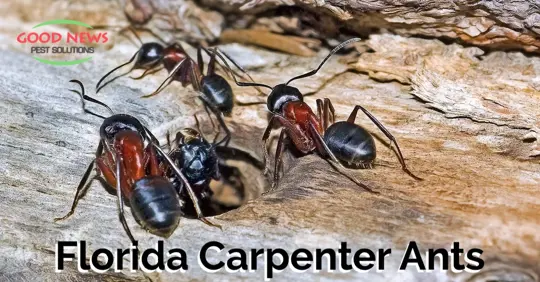
Camponotus floridanus, or Florida carpenter ants, are some of the largest and most conspicuous ants in the Sunshine State. They nest in decaying tree stumps, fallen branches and logs, as well as indoor crawl spaces, attics, untreated insulation and walls. They are sometimes mistaken for termites, but while they burrow into and hollow out wood, they do not eat it, and don’t cause nearly as much damage as termites.
While our temperatures rarely drop that much on the Gulf Coast of Florida, a momentary cold snap can encourage carpenter ants in firewood piles, wooden retaining walls or mulch beds to seek the warmer environs of your home. Once they’re established, they rarely leave of their own accord.
Carpenter ants are most noticeable, as we’ve already mentioned, because of their size. They measure anywhere from a quarter inch to more than half an inch long. They tend to be reddish -brown, or a mix of reddish-brown and black. You may also see some that are just black, but that’s slightly less common in our part of the state.
A fun fact: Florida carpenter ants will sometimes amputate an injured ant’s legs in order to avoid pathogenic infections from spreading throughout their body. The ants can instinctively tell the difference between wounds, and entomologists found the amputations increased survival odds for ants with femur injuries, but not tibia injuries.
Where They Hang, in Your Home
Carpenter ants favor areas with higher moisture – so not a surprise they love our humid atmosphere. In your home, look for them nesting in bathrooms, kitchens and laundry rooms. They also like hollow-core doors and foam insulation. Carpenter ants are most active during the summer months: May to August, and slightly less active March, April, September and October. That’s also when active colonies may send out winged alates to mate and establish new nests.
Outside they inhabit rotted wood and tree stumps but also enjoy thick mulch beds. That’s one of the main access points for their entry into homes - overgrown landscaping that touches siding, or mulch beds piled against foundations. They also follow branches and utility lines to sneak into your home, or crawl in around plumbing pipes with adequate, but not complete sealings.
Sugary substances and food crumbs can attract carpenter ants. Pet food left in bowls, pantry items not properly sealed and even the smallest crumbs on countertops become open invitations for infestations. If you haven’t already – and you absolutely should – store dry good and uneaten food - human or pet - in tightly sealed containers. That keeps the pests, and the humidity out.
As stated, carpenter ants don’t digest wood, but they do chew on it. The chewed-up material to build their nest is called frass. When they’re active, you will find piles of frass near nest openings, on windowsills, door jambs, corners and edges of paneling or wainscoting.
Escorting Them Off the Premises
The best way to prevent carpenter ants from overstaying their welcome is to keep things clean. Spilled food, even a tiny bit, draws ants and other insects. Outside your home, keep your hedges trimmed, remove old tree trunks or any other rotting wood promptly, and make sure none of your trees touch your home. Double check firewood before you bring it indoors.
An ounce of prevention is worth a pound of cure… One of the best defenses we offer our clients is really a cost-savings offense: Good News Pest Solutions TAP insulation. Thermal Acoustical Pest Control Insulation is a type of blown-in insulation that is imbued with organic, biological treatment products that kill bugs that try to move through it.
TAP is made from recycled newsprint, not the scratchy pink stuff that can be a health hazard. TAP is laced with a specialized form of boric acid that’s safe for your family, but deadly for insects and their nests. Our insulation is not only safer, it’s also more effective, both in temperature control and sound proofing. It’s also fire resistant. For more details on TAP or any of our green pest control solutions, please give us a call!