
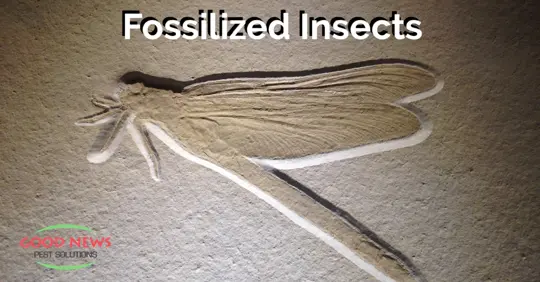
33 years ago, John Hammond and Mr. DNA introduced the world to probably the most famous insect fossil ever - the mosquito carrying dinosaur blood in Jurassic Park. While it was a fictional representation, it points viewers to the very real fossils of various insects found in the earth, right alongside dinosaur bones, stromatolites, and ancient human remains.
Today, October 15th, is National Fossil Day. So we thought it’d be fun to talk about insect fossils, how old they are, and what has been found – or not – over the years.
Aging Out
It’s true: just like Jurassic Park theorized, we know there were mosquitoes during the time of dinosaurs, along with wasps and earwigs. Spiders, silverfish and dragonflies go back even further. We have evidence that they existed more than 400 million years ago. Spiders may have been the first creatures to live fully on the land. Beetles predate Egypt and the pyramids by some 300+ million years.
In 1919, Reverend William Cran, M.A., discovered what is believed to be the oldest insect fossil. Cran. Rhyniognatha hirsti was a now extinct insect that was essentially a silverfish with wings. The pastor found the head part of the specimen in a layer of Devonian sedimentary rock in Aberdeen Scotland and donated it to entomologist S. Hirst. To this day, there is some debate that it might actually be closer to a millipede or centipede than a true insect.
Fabulous Fossils
They say cockroaches are the most resilient of all insects, pointing out their long-held existence on the earth and the likelihood they can survive a nuclear blast. Scientists believe some form of cockroach existed up to 320 million years ago. Fossils of orange head and peppered cockroaches have been found in rocks and in fossilized bat poop. Studying these distant cousins of our modern-day cockroaches gives us insight into their legendary adaptability.
Going back another 5 million years, we have the making of a 1950s horror film - fossils of dragonflies with wingspans as large as 3 feet apart. The largest modern dragonflies hit 6 inches from tip to tip. The closest relatives to the Odonata Anisoptera were actually first on the scene much more recently, alongside the Stegosaurus in the Jurassic age.
It’s no surprise that we have many insect fossils. Fossils come about when ancient plant or animal remains are rapidly buried, preserved, and transformed into stone. That can happen as the result of a sudden volcanic eruption, a flash flood or an intense overnight freeze. Since many bugs have hard exoskeletons, they may survive longer than most remains, trapped in place as the world hardens around them. Others are preserved in tree sap that hardens to a semi-translucent amber.
National Fossil Day
Since 2010, National Fossil Day puts a spotlight on the scientific and educational value of fossils. The holiday was originated by the National Park Service and every year features a different logo that pictures a prehistoric organism. This year, the White Sands National Park graphic was chosen, depicting several ice age beasts like wooly mammoths and the footprints of short-faced bears, saber-toothed cats, giant ground sloths, and humans.
Visiting National Parks is encouraged on National Fossil Day, as well as checking out local museums. Do a little reading or even a deep dive on fossils to learn more. Let others know you’re celebrating on social media with #NationalFossilDay.
Overall, insect and spider fossils are rare in national parks. The exception is Florissant Fossil Beds National Monument, where you can see fossils of a wide variety of terrestrial arthropods in caves, often preserved in bat guano.
What’s Missing?
You may have noticed that several insects we didn't mention don’t have a distinctive fossil presence, not even traces. Bugs like ants, termites and bees are not present because scientists believe they didn’t exist yet. Since there were no flowering plants in the time of the dinosaurs, there was no need for pollinators – and nothing for them to eat either.
Entomologists say when flowering plants and trees bearing fruit started springing up, bees and ants appeared too. They believe both may have evolved from ancient wasps, while termites came from wood eating cockroaches.
If you’re wishing some of these annoying invaders had never come about, let alone snuck into your home, we can help. Our Green Perimeter Plus solution takes care of ants, roaches, silverfish and spiders while keeping your home safe for your family and four-legged friends. For more details on how we evict and control them, or to schedule your first home inspection and treatment, please give us a call!