
Welcome to the second full day of autumn 2026. Because of the rotation of the earth and how the seasons work, the equinox, the official division between summer and fall, snapped into place at 8:04 pm Tuesday the 22nd of September. Of course, since we live on the Gulf Coast of Florida, you’re not going to see much of the leaves changing or temperature dropping around these parts.
But we do get to see the daylight change and the nights get longer, with or without daylight saving time.
Counting the Days
Our seasonal calendar is broken up by solstices and equinoxes. The summer and winter solstices mark when the sun is highest and lowest in the sky. The summer solstice is the longest day and shortest night of the year. The winter solstice flips that as the longest night and shortest day.
Equinoxes are literally the midpoint. The word comes from the Latin – aequus meaning equal and nox meaning night. On those days, the sun “stops” at the equator for a split second, marking exactly half a day of sun and half a day of night.
Fun fact: today, we’re better at measuring and we know now that true 12-hour equal light days, or equiluxes, happen a few days after we mark the equinox.
Visual Changes
By the way, did you know that when the leaves change color, they’re not dying? God’s creation is so well designed that the plants and trees can actually track the changing seasons even better than we can. That’s also why the changes occur at different times if you’re in Connecticut as opposed to Texas or Colorado.
The trees sense the change of the sun’s length and intensity as the earth slowly rotates away, so they stop producing the chlorophyll that makes the leaves green. The yellow, red, and orange colors have always been in the leaves. But as the green color fades, the other pigments, the carotenoids and anthocyanins, begin to come through. The specific colors have to do with how much sugar is left in the leaves and how it reacts to the sun.
The leaves fall off so the trees can preserve their energy, like a wooden battery holding its charge until the sun starts to come back, at which point the tree sends out new leaves to collect the solar energy.
And the Earwigs?
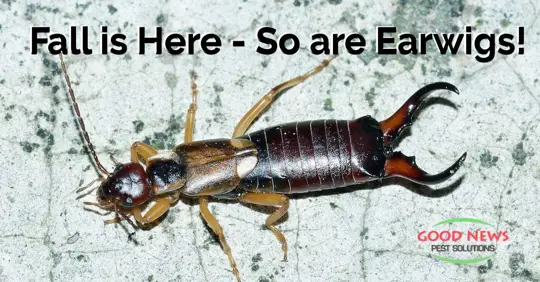
Dermaptera are nocturnal and love damp, wet areas. They have flat, elongated bodies, a pair of antennae, and two forceps-like pincers. They look a little scary but they don’t attack or even care about humans. They’re just running around looking for prey – small, soft-bodied insects like aphids, mites, maggots, scales, caterpillar eggs, and insect larvae. They also eat decomposing plants.
In Florida, as we shift to slightly cooler temps but the rains continue, earwigs will try and find their way into our homes. Door gaps, vents, cracks and crevices give them a way to get in and camp out in our kitchens, bathrooms, and sometimes laundry rooms.
We see six families of earwigs in Florida. The most common are the ring-legged earwig (Euborellia annulipes), striped earwig (Labidura riparia), and lined earwig (Doru taeniatum).
Oh, and contrary to popular belief or urban myths, they do NOT crawl into your ears while you sleep. That would probably creep them out even more than it would you.
If earwigs make their way into your home, you can try treating damp areas, like under sinks and around toilets with diatomaceous earth or boric acid. In a pinch, you can also use Borax detergent, but it’s not as effective. The best way to control earwigs is to seal up all those entry places around your home, bearing in mind that even the smallest opening can let earwigs, ants, and roaches into your home.
That’s the main reason our Green Perimeter Plus solution starts with an inspection of your home where we recommend sealing up all those spots, including the ones the average homeowner might miss. Then we treat for the insects inside, knowing there’s very little chance they’ll get back in. For all the details or to schedule your first treatment, please give us a call!