
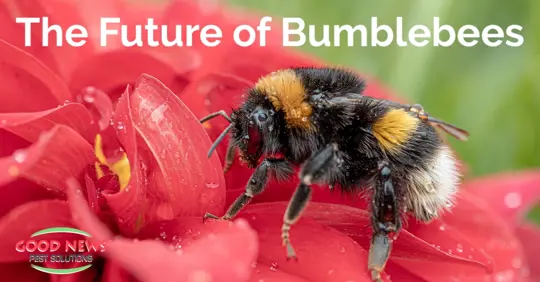
Bees are essential to our agriculture. Bumblebees are vitally important for human life on earth. “If the bee disappears from the surface of the Earth, man would have no more than four years left to live.” That popular “quote,” attributed to physicist Albert Einstein emerged in the 1990s. It is highly unlikely that Einstein said it, but the fear of losing our primary pollinators keeps it in circulation.
The problem with quotes like that is they overexaggerate the problem, making it easier to ignore, and the stats make them easy to disprove. Ask any agricultural scientist and they’ll point out that staple crops like wheat, rice, and corn are actually wind-pollinated. But – and it’s an important but – bumblebees are vital to our lives, pollinating approximately one third of the foods we eat. Not to mention the flowers and other plant life eaten by livestock, etc.
And they are in danger.
Pesticide Genocide
Conservationists are fond of saying we are in an insect apocalypse. And while they may sometimes overemphasize danger and promote fear, we are learning about new hazards every year resulting from widespread use of pesticides. One of the biggest threats we face on the earth is the fact that harmful chemical pesticides do more than control nuisance bugs. They also can hurt the insects who are beneficial to us.
For example, Sulfoxaflor, a next-generation pesticide introduced in 2013, kills sap-feeding pests like aphids in soybean and corn fields. But Sulfoxaflor is known to be toxic to bees. And it’s extremely difficult to use it to target aphids in one month and avoid harming honey bees at the same time.
Sarah Orr, assistant professor at the University of Tampa explains: "We need pesticides to control crop pests, but they can also harm essential non-target insects like bumblebees. As a scientist, my goal is to identify practical solutions that support pest management while also protecting beneficial insects and the food systems that depend on them."
Orr led the work on a recently published study while she was a postdoctoral fellow at the Georgia Institute of Technology. The research finds that some pesticides, including the aforementioned Sulfoxaflor, actually rewrite bumblebee DNA, changing their makeup and how they reproduce – or don’t. Even low levels of exposure may affect bee reproduction at the molecular level.
Rewriting the Code
The team at Georgia Tech found evidence proving Sulfoxaflor changes both gene activity and reproductive function in bumblebees. When exposed to low doses of the pesticide, bumblebees' genetic expression changed. The biggest issue appears to be changes in ovarian tissue, which may lead to a reduction in offspring.
Fewer bees reproducing, or producing smaller numbers of offspring, could further cripple an already strained bee population.
The study didn’t stop there. The goal of the research was to evaluate how different levels of non-lethal exposure affected bumblebees. Light exposure led to significantly reduced worker egg-laying and ovarian development. More exposure to Sulfoxaflor strikingly increased the chance the bumblebees would sting a person, even if they did not perceive them as a threat. And prior to killing the bumblebees with high levels of the pesticide, chronic Sulfoxaflor exposure impaired nest construction in microcolonies.
There is some good news. Sulfoxaflor does not appear to damage the bees’ brains or mental capacity.
Bumbling, Stumbling
Harsh chemical pesticides may be one of the biggest threats to bumblebees, but they’re far from the only one. As humans, we can be terribly disruptive to bee habitats and food sources without even meaning to. The more land we clear for development, the less space remains for wildflowers and other flowering plants that bees pollinate as well as rely on for their survival. That’s one of the reasons behind our area’s various tree replacement ordinances and push for more Xeriscape.
The chemicals used for construction and painting, as well as herbicides, can have some detrimental effect on bees. Further, the combination of chemicals, or the cocktail effect, can also have unforeseen consequences on bumblebees as well as other wildlife.
While we cannot control what farmers or gardeners spray on their land, Good News Pest Solutions has spent the past 30+ years looking for the most effective, least dangerous treatments we can apply to control and eliminate annoying insects from inside your home. Our Green Perimeter Plus handles the most common creepy crawlies who invade Florida homes at an affordable price. For more details, or to schedule your first visit, please give us a call!