
Last week we talked about how muggy August is here on the Gulf Coast of Florida and how that brings out more spiders than usual. We also pointed out that almost all spiders provide benefits to humans and most spiders are not a threat. This week, we’re going to talk about the spiders you do need to watch out for, including a near relative that can also lead to a painful revelation.
The Widows
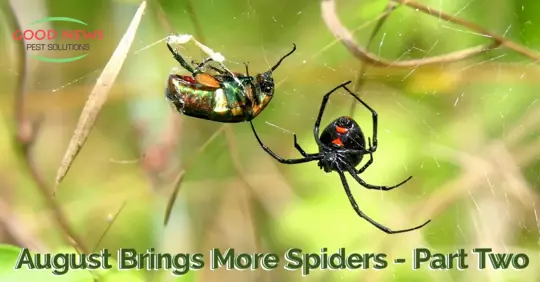
Likely one of the most iconic spider images in most people’s minds is the red hourglass shape on the back of a Black Widow spider. Latrodectus spiders can be found all across the globe. Females tend to be larger than the males, (family Theridiidae), ranging from a quarter inch to just over a half inch in size. Their abdomens are shiny and fat, like a giant black bubble – although some are lighter or even red or brown. In addition to the red hourglass (which varies in height and thickness), they may also have lateral stripes.
They build three-dimensional, conical shaped webs where they hide out when the sun is up, and prefer to hang out in rotted logs or around rocks, although they may hide behind boxes or crates in your garage or attic. Their chief points of impact with humans have almost entirely disappeared now: outhouses. The spiders would build their webs in the dark, dank area to capture the copious flies and other offal-seeking insects. Most bites came about when people would sit either on the spider, or blocking their access. Those bites were almost exclusively from female spiders, hence the misogynistic appearing name. Today, it’s rare for a widow spider to bite unless she’s trapped between you and your clothing.
Bites hurt immediately, but their true effects may not show up until hours later. The spider’s venom travels into your bloodstream, hitting the lymphatic system, causing nausea, vomiting, intense pain, rigid abdominal muscles, muscle cramping, malaise, local sweating, and raised blood pressure. The symptoms last 3-5 days. In the past, some bites proved fatal, but that is rarer now, and a visit to the ER can get you calcium gluconate and/or antivenin to alleviate the symptoms.
Florida has four species of widows: Latrodectus mactans: the southern black widow; Latrodectus variolus: the northern black widow; Latrodectus bishopi: the red widow; and Latrodectus geometricus: the brown widow. Brown widow spiders are not native to Florida, but have pushed many of the native widow species to the side.
The Recluses
There are no recluse spiders native to Florida. But, like Michiganders, Ohioans, and countless retirees, these highly toxic spiders have made their way into the Sunshine State and opted to stay.
In Florida, recluse spiders are considered the scariest spider boogieman. They are small, pale brown spiders with a distinct violin-shaped marking on their back. The spider’s venom can result in severe reactions like tissue damage, ulcers, and fever. Unfortunately, it is easy to mistake a different spider for a brown recluse. And it often happens.
An academic paper, published in 2001, points out that most recluse sightings are isolated and not proof of a recluse population in Florida. “...the verified records of brown recluse and related spiders in the state are limited to eight out of 67 Florida counties: Alachua, Bay, Dade, Duval, Jefferson, Leon, Orange and Osceola… There is no evidence to support either the notion that a widespread population of brown recluse spiders exists in Florida or that there are numerous introductions of brown recluse into the state.”
As of 2025, there has been a single verified brown recluse spider bite in Florida – a sailor was bitten on the hand by a male brown recluse in the cargo hold of a naval ship in Jacksonville right after it arrived from North Carolina in March 1986. Earlier this year, the Florida Brown Recluse Project published their findings: “The number of brown recluses found amounted to a whopping *zero*.”
Most spiders thought to be brown recluses are actually Mediterranean recluse spiders (Loxosceles rufescens). They are just as dangerous as brown recluses, but far less likely to bite, even when under extreme stress. Only when at risk of death itself will these spiders strike.
The Florida Scorpions
Scorpions are distant cousins to spiders. Thanks to decades of film and television portrayals, they are generally thought of as a threat only if you live in the desert. That’s not entirely true, although we only have three species here, as opposed to dozens in places like Arizona, New Mexico and western Texas.
The Florida Bark Scorpion, or slender brown scorpion, can grow up to 4 inches long, the largest we see in the state. As per their name, they prefer to stay in or near dried bark or mulch. Bark scorpions are nocturnal and when indoors often hide under boards in new construction or abandoned homes. The sting is not that venomous but can be extremely painful.
The most common scorpion found across Florida is the Hentz Striped Scorpion. They are darker in color than some other scorpions, with greenish-yellow stripes on their midsection. Hentz scorpions eat roaches and can be spotted beneath stones and other debris on the ground.
Guiana Striped Scorpions tend to be seen only in the southernmost parts of Florida: Miami-Dade, Collier, and Monroe counties. Their yellow bodies can range between 1 and three inches long. They’re equal opportunity hiders, scurrying away under stones, bark or in vegetation. Their sting affects humans in one to five hours.
If you’re attacked by a Florida scorpion, it will sting, but the effects are more fleeting and not at all deadly. Effects include swelling and allergic reactions. You should know Florida scorpions are not aggressive and usually only react if they are pinned against your skin, trapped in clothing or sheets.
Biting Back
You may have noticed a pattern. Although each of the arachnids we listed will bite or sting, and all have some venomous content in their defense mechanism, it’s just that – a defense. As long as you’re not pressing the spider or scorpion up against you, there’s a slim chance you’ll get hurt. And even if you are, treatment is relatively easy, with a little more effort needed for our friends with allergies.
Still, you don’t want them running around your house. Spiders are covered as part of our Green Perimeter Plus solution. For an affordable fee, we inspect your home and recommend sealing up any unexpected entry points, and rid your home of spiders, silverfish, roaches and ants. We follow up with three scheduled annual visits, and of course, we will come back if an insect problem persists. To find out more, or to schedule your first appointment while the kids head back to school, please give us a call!