
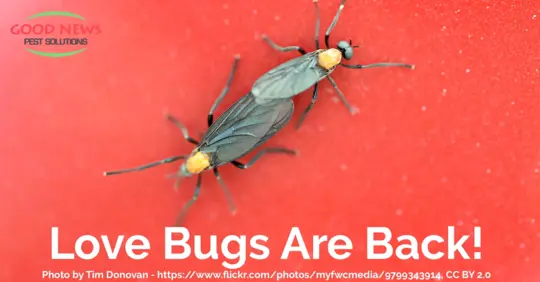
As we wrap up August and look towards September, there are a few things that stay constant. School’s back in session – watch out for kids walking and speed cameras tracking. The daily summer rains will get shorter but not disappear (and we’re still in hurricane season). Our cars will again be splattered with the acidic, amorous insects who engage in intimate acts on the highway… Love bugs.
It’s a twice a year ritual here on the Gulf Coast of Florida, taking your vehicle through the car wash almost daily to keep Plecia nearctica from sticking and ruining your paint job. With so many that are killed on a daily basis, it’s no surprise they developed two mating seasons every year. So, every spring and end of summer we have to deal with them hovering in the air, then thwack! On our windshields and engine grills.
Bugging Out
Love bugs seem to have appeared almost out of nowhere in the 60s and 70s. But growing development was probably the main cause. Between the carpetbaggers relocating to Florida and an influx of military folks post-World War II, a problem began to emerge. In the 80’s, it’s estimated that a thousand people per day were moving to the Sunshine State. There wasn’t enough housing to go around and land was still relatively cheap. So building projects began. A LOT of building projects. Those pushed love bugs, as well as many other insects and rodents, out of their natural habitat.
With love bugs in particular, they found themselves attracted to the other thing growing in South Florida – traffic. Automobile exhaust, when exposed to sunlight, transforms into UV-irradiated aldehydes. These modified fumes mimic the scent of the decaying organic matter where they would naturally lay their eggs.
Females were drawn to the highway, thinking, or instinct-ing?, that they were finding new places to lay eggs. And where the females go, the males follow. Up to 8 males for every available female. When the bugs mate, they connect, backside to backside and float through the air in a strange mating dance. Some make it to the berms where they lay their eggs. Others end the dance in a spectacular fashion across the hood of a car. Either way, they only live three to four days as adults.
Believe it or not, we have fewer love bugs these days due to a variety of reasons: habitat loss, light pollution, climate change, changes in spring runoff in aquatic systems, pollution, and pesticide use.
While we may find love bugs to be a nuisance, they do provide a valuable piece of our ecosystem. The larval stage contributes to decomposition, essential to healthy soil and plant life.
Best Cleanser
Now that most folks are back to a daily commute, you can expect to plow through several dozen pairs of love bugs, if not hundreds, every day during their semi-annual swarming season. The easiest, but probably most expensive, solution is to run your car through the car wash every day. Look for one that’s as close to home as possible that also offers unlimited cleans. You can also hose off the debris when you get home or try installing a fine mesh net across your car’s front end. Both Walmart and Amazon stock them at various price points.
What you don’t want to do is try spraying insecticides. These will do more damage to you than the love bugs. And you’ll still have to wash them off your car.
You definitely don’t want to leave the bugs on your vehicle, though. The fluids in their bodies can act like an acid on your paint, especially when baked in the hot Florida sun. Too many bugs building up can also clog your radiator or air filter, causing less fuel efficiency or even overheating and engine damage.
While their numbers may be dipping a bit, love bugs are still something drivers on the Gulf Coast of Florida will have to deal with, at least for the few months every year they’re swarming. Other invasive bugs are easier to deal with – at least in your home – with our Green Perimeter Plus solution. Ants, roaches, spiders and silverfish all disappear from your home after we come through with our inspection, seal up entry points and utilize green, organic treatments safe for your whole family. All for an affordable price. For more details, or to schedule your first appointment, don't wait, give us a call today!